Afterthoughts
In my book Look At It This Way: The Blind Leading The Sighted, I wrote a chapter called Sheltered and Unsheltered. In it, I explored the difference between blind people who are protected from the world and those who have been given the tools, space, and confidence to move through it on their own. In this essay, I want to go deeper. I want to name something that many blind people experience but rarely say out loud.
I want to talk about what it means to be treated as an afterthought.
An afterthought is someone whose presence is acknowledged but not truly considered—someone included in form, but not in value. It is like being invited into a meeting after the decisions have already been made. There is a seat for you, but no one pauses to ask what you think—because it is quietly assumed you have nothing essential to add.
I am not speaking for every blind person. But most of us will recognize what I’m about to describe. And for those of you who can see, some of this may be uncomfortable. That’s okay. Growth often is.
It is very common for blind people—especially those raised in predominantly sighted families—to feel like we are in the way. Not just emotionally, but physically.
Physically in the way looks like people stepping around you instead of beside you. It looks like being moved without being asked. A hand on your arm redirecting you mid-step. Fingers grabbing you to hurry you along. Being physically repositioned while people continue talking, as if your body is something to manage rather than a person to respect.
It feels like people rearranging themselves because of you. Like you are an obstacle to navigate around instead of someone to move with. The pace changes. The energy shifts. You can feel the adjustment.
No one may say, “You are a burden.” But your body registers it anyway.
Emotionally in the way is quieter, but just as real. It shows up in apologizing unnecessarily. In over-explaining yourself so you won’t be misunderstood. In thanking people excessively for ordinary consideration. In hesitating before asking for something normal because you don’t want to inconvenience anyone.
Many of us think twice before we speak. Think twice before we ask. Think twice before we take up space.
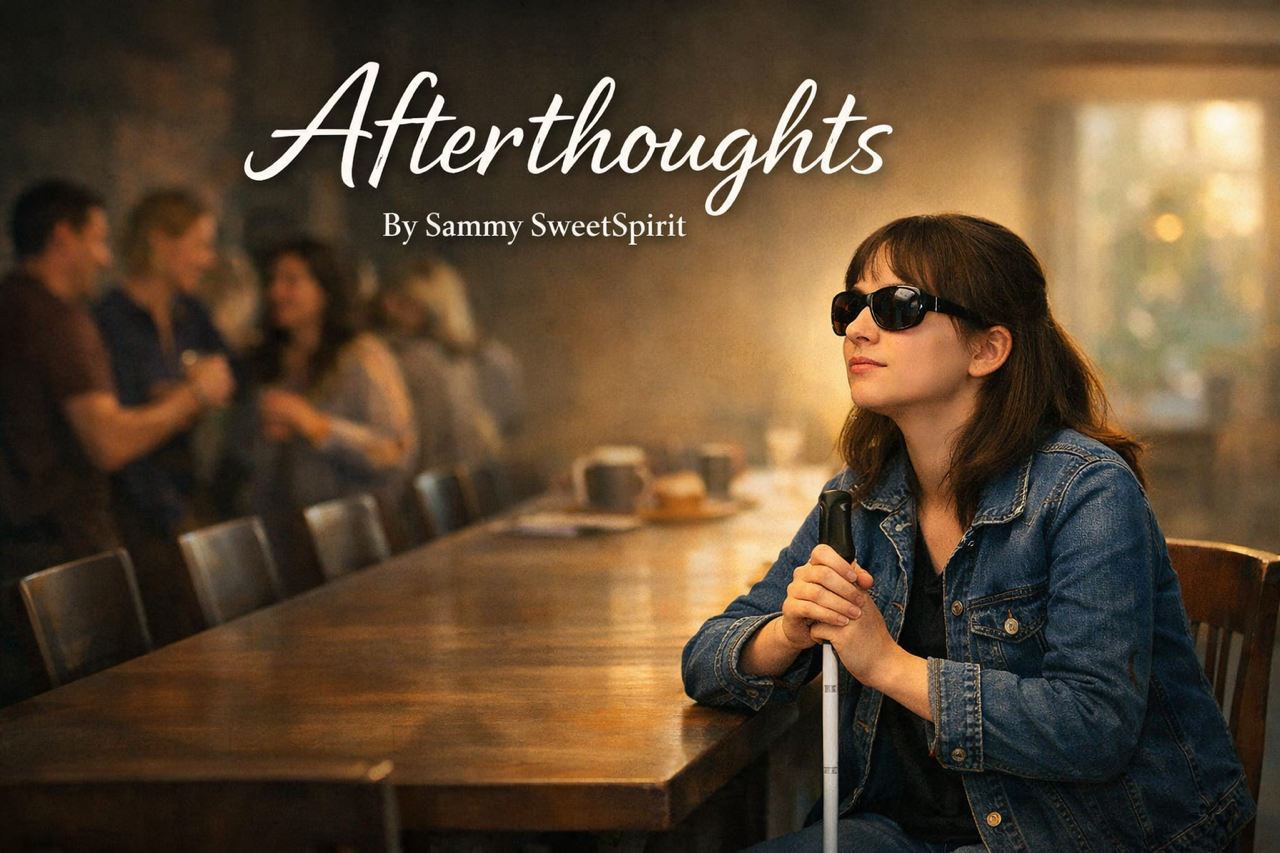
There are times when we go to someone’s house for a small gathering or a party and are quietly placed in a chair off to the side. We are offered food and something to drink, and then the conversation continues around us. Polite, but distant. Included in logistics, not in dialogue. There is so much conversation that could be had—about ideas, experiences, humor, opinions—but it simply isn’t. The silence says more than words.
Let me ask something simple. If you were moving something heavy and needed help, would you ask the blind person in your life to help you? Most people would not. They would automatically look for someone else. And that is exactly part of what I mean. So many blind people are not seen as useful before we are even given the chance to be.
From the sighted side, this often grows out of overprotectiveness, low expectations, impatience, and assumptions. Sometimes it comes from discomfort—simply not knowing how to relate to blindness. But whatever the source, the result can feel the same.
You begin to wonder if your presence requires too much adjustment.
You begin to shrink without meaning to.
There is an unspoken assumption that blindness limits understanding. That somehow we don’t know enough about life to offer advice. That we haven’t experienced “the full picture.”
But I can assure you—we have experienced more than you think.
In my own family, in friendships, and in romantic relationships, I have often felt like the afterthought. Not the first person considered. Not the one taken seriously. Not the one assumed to be useful.
There have been moments in my own family when it was clearly unexpected that I would share an opinion. As if my perspective was surprising. As if I had crossed a line simply by thinking differently. I have voiced my thoughts and been met with shock. Or dismissal. Or the familiar phrase: “You don’t even know the half of it.”
Maybe not. But I know enough.
In heated conversations, I have found myself saying, “I have thoughts too. Why are you only interested in your own?” That plea doesn’t come from ego. It comes from years of being subtly sidelined.
Not everyone in my family treats me this way. But enough have. There have been times when it was assumed I would simply “be fine” with whatever happened. That decisions could be made about my space, my belongings, my life—without consulting me. That I would adapt. That I would accept.
Once, I was asked how I felt about a significant decision that would affect my home. I expressed clearly that I did not want it to happen. I am an adult, and I get to make decisions about how I live and what happens in my own space. Peace in my house matters deeply to me. My answer was dismissed almost immediately.
A sighted person might say, “This has nothing to do with your blindness.”
But that is exactly the point.
You would not treat someone you truly see as your equal this way. You would not override their voice in their own home. You would not hear their boundary and decide it carries less weight. When something like that happens, especially in a space that belongs to you, it reveals something deeper about how blindness is perceived.
I am not a psychologist. But I believe there is a psychological component to how society relates to blindness. Blindness is treated as more than the absence of sight. It is often unconsciously associated with fragility, dependence, limitation, or diminished authority. And when those assumptions go unchecked, they shape behavior.
Over time, blindness stops being just a physical characteristic and becomes a social identity loaded with meaning—meaning we did not choose.
Do you know what that feels like?
It feels like blindness is being equated with lesser value. Like being blind somehow means being less capable of knowing what you want. Less worthy of consideration. Less human.
There is another layer to this dynamic. Many sighted people remind themselves—consciously or not—of the help they have given us. The rides. The reading. The accommodations. And somewhere in that mental accounting, an imbalance forms. We should be grateful. We should be agreeable. We should not challenge. We should be helped—but not heard.
Is that the world we want to live in?
Every person deserves a voice. Every person deserves to express their thoughts and feelings. Blindness does not cancel humanity.
In my book, I share an example: imagine a crime occurs, and several people witness it—including someone who is blind. Would you ask the blind person what happened? Or would you assume they have nothing to offer because they could not see?
We may not describe visual details. But we can tell you what we heard. What we sensed. What we noticed in tone, movement, atmosphere. Our experience is different—but it is no less real. And it is no less valuable.
Here is something many people find heartbreaking: a lot of blind people are not used to being asked what we think. When a friend genuinely asks for my opinion, I am sometimes surprised. Surprised that my perspective is wanted.
That should not be surprising. But it is.
Experiences like these have shaped me—but they have not hardened me. I am not hardened. But I will tell the truth. I have no problem saying what is uncomfortable if it means change can be made. So many people do not realize the behavior they are displaying. They are not paying attention to what they are doing. I am here to shed light on it—not to shame, but so we can all connect better as human beings.
Instead of closing me off, these experiences have made me intentional. I go out of my way to let people know they matter to me. That they are seen. That their thoughts are welcome. That their opinions count. I make room at the table because I know what it feels like to be left standing beside it.
So this essay is for all the afterthoughts.
For the ones not immediately considered.
For the ones assumed to be fine.
For the ones whose voices are overlooked.
You are not in the way.
You are not a burden.
You are not background noise.
You are valuable.
You are capable.
You are important.
You have a voice.
Use it.